
'This is a technology that will particularly benefit those who want to take agency over it'.

'The West Asia or the Gulf crisis has shown that what we develop as national infrastructure when things are not as bad as they could be, we forget to plan for adversities.'

India's main inflation measure, the Consumer Price Index (CPI), is set for another major update, even though it has been in its current form for only about 15 years.

Odisha and Uttar Pradesh are among the first to roll out the digital exercise.

India's economy experienced a growth of 7.8 per cent during the October-December quarter of 2025-26, according to the new series of national accounts with 2022-23 as the base year.

"It is quite possible that the rates will remain low in the near to medium term, but that will depend on how conditions evolve," said RBI Governor Sanjay Malhotra.

The ruling is expected to have wide-ranging consequences for global trade, businesses, consumers, inflation trends and household finances across the country.

Investors and startup executives are calling for extending the period for an entity to be recognised as a startup from 10 to 15 years for deep-tech companies.

The new rules allow for a staggered implementation road map, giving companies, data fiduciaries, data principals, and other stakeholders up to 18 months to comply with the administrative guidelines under the DPDP Act.

The proposed guidelines cover several key parameters, including governance, investor protection, disclosure, testing frameworks, fairness and bias, and data privacy and cybersecurity measures.
The 2026-27 Budget, seeking to harmonise the government's imperative to grant certainty while ensuring a rational tax policy, had several notable announcements to usher in halcyon days, says Mukesh Butani.

Governments should move away from universal subsidies towards tightly targeted transfers, backed by stricter eligibility norms, sunset clauses and periodic audits to curb leakages and improve spending efficiency, a joint study by Asian Development Bank and PwC has recommended.
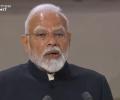
Prime Minister Narendra Modi advocated for a global framework for artificial intelligence (AI) based on open source, emphasizing the need for trust, transparency, and the elimination of biases. Co-chairing the AI Action Summit with French President Emmanuel Macron, Modi highlighted the transformative potential of AI across various domains, including politics, economics, security, and society. He stressed the importance of democratizing technology, addressing concerns about cyber security and disinformation, and developing quality data sets free from biases. Modi also acknowledged the need for open-source AI ecosystems to foster trust and transparency, while emphasizing the importance of localized technology for effectiveness and usefulness. Recognizing the potential of AI to improve health, education, and agriculture, Modi proposed pooling resources and talent to leverage the technology for sustainable development goals. Addressing concerns about job displacement, he emphasized that while the nature of work may evolve, technology creates new opportunities. Modi highlighted India's leadership in AI adoption and data privacy solutions, emphasizing the nation's readiness to share its expertise and contribute to an AI future that benefits all.

At the heart of this debate is Section 3(d) of the Patents Act, a safeguard designed to prevent drugmakers from extending monopoly protection through trivial modifications to existing medicines.

'We are in touch with industry to further compress the timelines.'

The Centre is considering amendments to the Recovery of Debt and Bankruptcy Act in the Budget to allow some Debt Recovery Tribunals to focus only on high-value cases.

The rupee plunged 26 paise to an all-time low of 90.75 against the US dollar in intra-day trade on Monday, weighed down by uncertainty over an India-US trade deal and persistent foreign fund outflows.

India's retail inflation, which has stayed below the Reserve Bank of India's (RBI's) 4 per cent target in recent times, is likely to remain benign in the coming months, RBI Deputy Governor Poonam Gupta said in a speech, on Friday, which was uploaded on the central bank's website on Tuesday. Headline inflation dipped to multi-year lows of around 1.5-2.8 per cent in late 2025.

India is growing fast, but to keep growing strong, the government must make more things at home, create jobs, and spend money wisely, suggests Rajiv Memani, regional managing partner, Africa-India Region, EY.

'The additional Rafales will be from a vastly improved version compared to the 36 acquired for the IAF under the 2016 deal.'

This weekend, Donald Trump has begun to say the quiet part out loud -- that he wants to take control of Iran's oil, a formulation more in line with his robber-baron style of international relations.

The insurance industry is trying to get to grips with provisions in the proposed Insurance Amendment Bill, which gives additional powers to the Insurance Regulatory and Development Authority of India (Irdai), while there is ambiguity in the very definition of the insurance business, according to industry experts.

'Every day the meter is ticking. Like a time bomb.' Shipping giants are billing Indian exporters up to $3,000 per container in war surcharges -- on cargo that sailed before the war began -- as the Strait of Hormuz shuts down.

The best way for India to prepare is by preserving and strengthening the RBI's hard-won credibility, point out Rajeswari Sengupta and Vaishali Garga.

We will explore some of the reasons why a stock-only portfolio may no longer be sufficient and some of the modern alternatives and strategies that can help investors build resilient and profitable portfolios.

'The next two to three weeks will not be decided in Washington.' 'They will be decided in Tehran, in whatever calculation Iran makes about the costs of continued resistance against the costs of appearing to have yielded.'

The Union health ministry has issued draft rules to mandate a blue vertical strip on all antimicrobial drug labels, aiming to rein in over-the-counter misuse and tackle India's growing antimicrobial resistance (AMR) problem.

Government schemes such as the PM E-Drive initiative, with allocations of around Rs 2,000 crore for charging points deployment, are helping accelerate rollout

Various stakeholders told the committee that there is a need for expanding judicial capacity or restructuring the adjudicatory process by increasing the number of benches and also enhancing financial allocation for improvement of infrastructure.

'There were two options before the government -- create a complex, cumbersome law, which will cause a tremendous amount of compliance challenges for startups or say let's go back and do a clean slate, where we do a framework of laws and policies'

Taking Kharg would give the US control over virtually all of Iran's oil exports and thus provide significant leverage, notes Prem Panicker in his must read daily blog on the Gulf War. It would also put American troops within range of Iran's remaining missiles, drones, and artillery on a piece of real estate that is just eight square miles in size, and just 15 miles from the Iranian mainland.
This Budget positions India's taxation ideology as not merely a revenue source but as a strategic catalyst for growth, inclusion and long-term confidence.

The Supreme Court's stay on the UGC equity regulations aimed at preventing caste-based discrimination on campuses has been met with mixed reactions. Opposition parties welcomed the decision, while some expressed concern over the implications for marginalized communities.

'It will increase the contribution to gratuity, which is something the employer has to give.'

Largecap equities are less volatile than mid- and smallcap stocks, making them suitable for risk-averse investors.

Reiterating Sitharaman's statement that this is a youth power budget, Modi emphasised that the provisions made in the budget will prepare leaders, innovators and creators across different sectors.

'The emphasis is on execution, not identification.'

Across all sectors, the future of work depends on adaptability.

'What we are seeing today is India stepping into its digital confidence, not as a follower but a leader.'

With a confident new generation of innovators, India now has the scale and self-belief to shape its own digital destiny marked by creation, observes Ajay Kumar chairman, UPSC.
